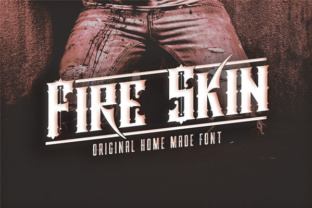
Fire Skin: A Detailed Evaluation of VMF Font’s Blackletter Typeface
In the landscape of digital typography, blackletter typefaces occupy a distinct and historically rich niche. Often associated with medieval manuscripts, religious texts, and traditional heraldry, these fonts carry an inherent weight of authority and heritage. However, translating such intricate historical forms into modern digital workflows presents significant challenges. Fire Skin, created by VMF Font, emerges as a contemporary entry in this crowded category, aiming to balance aesthetic authenticity with functional usability. For designers, marketers, and creative professionals seeking to evoke a sense of tradition, craftsmanship, or gothic elegance, understanding the specific capabilities and limitations of Fire Skin is essential before integrating it into any project.
The Essence of Fire Skin
Fire Skin is not merely a decorative script; it is a structured blackletter typeface designed with a focus on visual impact and readability within its stylistic constraints. The font draws inspiration from classic Gothic scripts but adapts them for modern display purposes. Its name suggests a certain intensity and sharpness, characteristics that are evident in its sharp serifs, high contrast between thick and thin strokes, and dense letterforms. Created by VMF Font, a studio known for producing specialized typographic assets, Fire Skin is positioned as a tool for creators who need more than just a standard sans-serif or serif but require something with immediate visual character.
The design philosophy behind Fire Skin appears to prioritize legibility at larger sizes while maintaining the ornate complexity that defines the blackletter genre. This makes it particularly suitable for headlines, logos, and poster designs where the text serves as the primary visual anchor rather than body copy. By focusing on display usage, VMF Font allows the typeface to shine without the common pitfalls of blackletter fonts becoming illegible when scaled down or used in long paragraphs.
Key Characteristics and Design Strengths
When evaluating Fire Skin, several structural elements stand out as defining features. First is the sharpness of the terminals. Unlike softer, rounded scripts, Fire Skin maintains angular precision, giving it a confident and assertive presence. This characteristic makes it highly effective for brands or projects that wish to communicate strength, history, or exclusivity. The sharp edges catch the eye and create a strong silhouette, which is crucial for brand identity work.
Secondly, the high stroke contrast is a hallmark of the font. The variation between the heavy vertical stems and the delicate hairlines adds a layer of sophistication and refinement. This contrast mimics the effect of quill writing on parchment, lending an organic feel to what is otherwise a rigid geometric structure. For designers working on luxury packaging, event invitations, or music album covers, this level of detail can elevate the perceived value of the final product.
Another notable aspect is the density of the letterforms. Blackletter fonts often suffer from being too "busy" or difficult to scan quickly. Fire Skin manages its internal spacing (counter space) reasonably well, ensuring that individual characters remain distinguishable even when grouped together. This balance is critical for maintaining readability in short phrases or titles. While it may not be suitable for extended reading, its performance in concise messaging is robust.
Usability and Technical Flexibility
From a technical standpoint, Fire Skin offers a range of weights and styles that enhance its versatility. A comprehensive font family allows designers to create hierarchy and emphasis without switching typefaces. This consistency is vital for maintaining a cohesive visual language across different media, whether it be a website header, a business card, or a social media graphic. The inclusion of ligatures and alternate glyphs further expands its creative potential, allowing for custom compositions that feel bespoke rather than generic.
However, usability also depends on how the font interacts with other design elements. Because Fire Skin is visually dominant, it requires careful pairing with simpler typefaces for supporting text. Sans-serif fonts with neutral tones or clean slab serifs often complement blackletter styles well, providing a necessary visual break. Designers must be mindful of this dynamic to avoid cluttered layouts. The font’s strength lies in its ability to command attention, so it should be used sparingly and strategically.
Practical Applications and Industry Fit
Who benefits most from using Fire Skin? The answer lies in sectors where aesthetics drive engagement. Here are some specific scenarios where this font proves its worth:
- Branding and Logo Design: For breweries, craft distilleries, tattoo studios, or artisanal bakeries, Fire Skin provides an instant connection to tradition and craftsmanship. It signals quality and heritage without requiring additional imagery.
- Event Marketing: Concert posters, festival flyers, and wedding invitations often rely on dramatic typography to set the mood. Fire Skin’s bold appearance fits well with rock, metal, or vintage-themed events, adding a touch of theatricality.
- Publishing and Editorial: Magazine headers, book covers, and chapter titles can use Fire Skin to create a striking focal point. In editorial design, breaking up large blocks of text with a distinctive display font can improve visual rhythm and reader interest.
- Digital Content Creation: Bloggers and YouTubers looking to establish a unique brand voice might use Fire Skin for thumbnails or channel banners. Its high contrast ensures visibility even at small thumbnail sizes, provided the background is sufficiently contrasting.
For entrepreneurs and small business owners, Fire Skin offers a cost-effective way to achieve a professional look. Instead of commissioning custom calligraphy, which can be expensive and time-consuming, purchasing a license for Fire Skin provides a scalable solution. Freelancers and agencies can integrate it into their toolkit for clients who need a quick yet impactful typographic solution.
Potential Limitations and Considerations
No typeface is without its drawbacks, and Fire Skin is no exception. The most significant limitation is its lack of versatility in body text. Attempting to use Fire Skin for paragraphs of text will result in poor readability and user fatigue. It is strictly a display font. Designers must resist the urge to overuse it, as its visual intensity can become overwhelming if applied indiscriminately.
Additionally, the historical connotations of blackletter fonts can sometimes clash with modern, minimalist, or tech-focused brands. If a company aims to convey innovation, speed, or simplicity, Fire Skin may send the wrong message. It evokes the past, not the future. Therefore, audience alignment is crucial. A tech startup launching a new AI platform would likely find Fire Skin inappropriate, whereas a heritage watchmaker would find it perfect.
There is also the consideration of licensing and compatibility. As with any premium font, users must ensure they understand the terms of use, especially for web embedding and commercial merchandise. VMF Font’s licensing terms should be reviewed carefully to avoid legal issues. Furthermore, while most modern operating systems support OpenType features, older software or mobile devices may render certain ligatures or alternates inconsistently. Testing the font across different platforms is a recommended step before finalizing a design.
Long-Term Value and Final Verdict
Evaluating Fire Skin through the lens of long-term value reveals a solid investment for creative professionals. Trends in typography come and go, but blackletter styles have remained relevant for centuries due to their timeless appeal. Investing in a well-crafted font like Fire Skin ensures that designs do not quickly become dated. The font’s durability lies in its classic roots, adapted for modern needs.
For educators and students studying design history, Fire Skin serves as a practical example of how historical typefaces can be digitized and repurposed. It bridges the gap between academic study and practical application, offering a tangible resource for learning about letterform construction and visual hierarchy.
In conclusion, Fire Skin by VMF Font is a powerful addition to any designer’s arsenal. It excels in creating bold, memorable, and historically resonant visuals. Its strengths lie in its sharp aesthetics, high contrast, and suitability for display purposes. While it has clear limitations regarding body text and contextual appropriateness, these are typical of the blackletter genre. When used thoughtfully and paired correctly, Fire Skin can significantly enhance the visual communication of a project. For those seeking to add a touch of gothic elegance and authoritative presence to their work, Fire Skin delivers both style and substance.
Ultimately, the decision to use Fire Skin should be driven by the specific goals of the project. If the aim is to evoke tradition, craft, or drama, this font is a compelling choice. If the goal is clarity, neutrality, or speed, other typefaces may be more appropriate. By understanding its character and constraints, creators can leverage Fire Skin to produce designs that are not only beautiful but also effective and purposeful.