Schoensperger Der Altere: A Historical Anchor in Early Typography
In the landscape of digital design and typography, it is easy to overlook the profound historical lineage that underpins modern font development. Yet, for professionals seeking authenticity, depth, and a connection to the origins of print culture, understanding the provenance of typefaces is not merely an academic exercise—it is a practical necessity. One such pivotal figure in this history is Schoensperger Der Altere, also known as Johann Schönsperger der Ältere. His work in Augsburg during the late 15th century laid critical groundwork for the dissemination of knowledge, particularly through his printing of early Bible editions. Today, the legacy of his workshop lives on in specific typographic reproductions, such as the exemplar GTF 1 120G, which offers designers a tangible link to the dawn of the printed word.
The Historical Context of Johann Schönsperger der Ältere
To appreciate the value of the fonts associated with Schoensperger Der Altere, one must first understand the environment in which he operated. Augsburg, in the last two decades of the 1400s, was a bustling hub of commerce and intellectual activity. It was here that Johann Schönsperger established himself as a prominent printer. Unlike many of his contemporaries who focused solely on religious texts, Schönsperger’s output was diverse, yet his most enduring contribution remains his series of pre-Luther Bible editions. These were not simple reprints; they were carefully crafted artifacts that standardized the visual representation of scripture for German-speaking audiences before Martin Luther’s translations gained dominance.
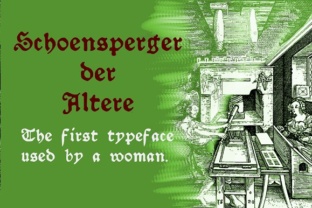
The significance of Schoensperger Der Altere extends beyond his own output. He was part of a family enterprise that included his sister, Anna Rügerin. Often cited as the first recorded female printer, Anna played a crucial role in the business, particularly in the production of Eike of Repgow’s Sachsenspiegel. This legal code, written in Middle High German, required a clear, authoritative typeface to convey its weight and importance. The collaboration between Johann and Anna highlights a period where printing was still a hands-on, familial craft, deeply integrated into the social and legal fabric of the Holy Roman Empire.
Analyzing the Exemplar: GTF 1 120G
For modern designers, the direct connection to this era is preserved through digital recreations based on physical specimens. The font identified by the designation GTF 1 120G serves as the primary exemplar for Schoensperger Der Altere’s style. This is not a generic "blackletter" or "fraktur" font designed for novelty; it is a precise reconstruction intended to capture the specific nuances of Schönsperger’s original metal types. When evaluating GTF 1 120G, several key characteristics emerge that distinguish it from other gothic typefaces.
- Historical Accuracy: The glyph shapes, stroke contrasts, and letterform proportions are derived directly from surviving impressions of Schönsperger’s work. This ensures that any document set in this font carries an inherent sense of historical legitimacy.
- Legibility within Genre: While blackletter scripts can be challenging to read in long passages, GTF 1 120G maintains a balance between decorative complexity and functional clarity. It is optimized for headlines, pull quotes, and short blocks of text where impact is prioritized over rapid scanning.
- Consistency: One of the common pitfalls in digitizing old typefaces is inconsistency in baseline alignment and x-height. The GTF 1 120G exemplar demonstrates a high degree of uniformity, making it reliable for professional layout work where precision matters.
Practical Applications and Workflow Integration
Who benefits most from using a typeface rooted in the work of Schoensperger Der Altere? The answer lies in projects that require a specific tonal quality: authority, tradition, and gravitas. For publishers working on historical non-fiction, legal documents, or academic journals focusing on medieval or early modern studies, this font provides an immediate visual cue to the reader about the nature of the content.
Consider the case of a small press publishing a facsimile or a new edition of a classic German legal text. Using a modern sans-serif would create a dissonant aesthetic clash, undermining the perceived authenticity of the source material. In contrast, employing a font like GTF 1 120G aligns the presentation with the content’s heritage. Similarly, marketers for heritage brands—such as breweries, distilleries, or artisanal food producers with deep regional roots—can use this typeface to evoke craftsmanship and longevity. It signals to the consumer that the product is not mass-produced but rather rooted in a long-standing tradition.
However, integration requires strategic planning. Schoensperger Der Altere’s style is visually dense. In web design, where screen resolution and loading times are constraints, heavy blackletter fonts can sometimes render poorly at smaller sizes or cause accessibility issues for users with dyslexia or visual impairments. Therefore, its use should be reserved for display purposes. Pairing it with a clean, neutral sans-serif for body copy is a best practice. This combination allows the historical weight of the header to stand out while maintaining readability for the general audience. For example, a blog post discussing the history of printing might use GTF 1 120G for section headers and a modern geometric sans-serif for the explanatory text, creating a harmonious dialogue between past and present.
Evaluating Quality and Long-Term Value
When assessing the utility of any digital asset, reliability and flexibility are paramount. The GTF 1 120G exemplar, being tied to the specific output of Schoensperger Der Altere, offers a unique value proposition: it is not just a font, but a curated piece of cultural heritage. For professionals in the creative industries, having access to such specialized tools expands their expressive palette. It allows them to communicate complex ideas about time, history, and tradition without relying solely on imagery or extensive copywriting.
Furthermore, the robustness of the font file itself is a critical factor. A well-constructed typeface will include a comprehensive character set, supporting various diacritics and punctuation marks necessary for European languages. Given the origin of Schoensperger Der Altere in Germany, proper support for umlauts and eszett (ß) is essential. If the font lacks these, its usability is severely limited. Designers should verify that the version they acquire includes these necessary glyphs to ensure seamless integration into multilingual projects.
There are also limitations to consider. The stylistic rigidity of blackletter means it does not adapt well to modern, minimalist design trends that favor open space and simplicity. Attempting to force this typeface into a sleek, tech-forward interface will likely result in visual clutter and user frustration. Its strength lies in its specificity. It is a tool for context, not a universal solution. Understanding when *not* to use it is as important as knowing when to apply it. For instance, it would be inappropriate for a startup landing page aiming to convey innovation and speed. It belongs in spaces that value endurance and legacy.
Conclusion: Bridging Past and Present
The story of Johann Schönsperger der Ältere and his sister Anna Rügerin is a testament to the power of print in shaping society. Their work in Augsburg did more than produce books; it helped standardize language and law across regions. Today, the digital reproduction of their work, exemplified by GTF 1 120G, allows contemporary creators to tap into that same reservoir of authority and authenticity. For designers, educators, and publishers, Schoensperger Der Altere is not just a nostalgic reference but a functional resource. By using it thoughtfully, respecting its historical context, and applying it with technical precision, professionals can enhance their projects with a layer of depth that resonates with audiences seeking substance over style. In an era of fleeting digital trends, grounding designs in such rich historical foundations offers a timeless alternative.